

Jump to content Jump to search

Course collections

Course collections contain literature that is particularly relevant to a specific course. They are made available as print or electronic collections for the duration of the semester.

Teaching staff can find information on setting up a course collection here and students can learn more about using the course collections.

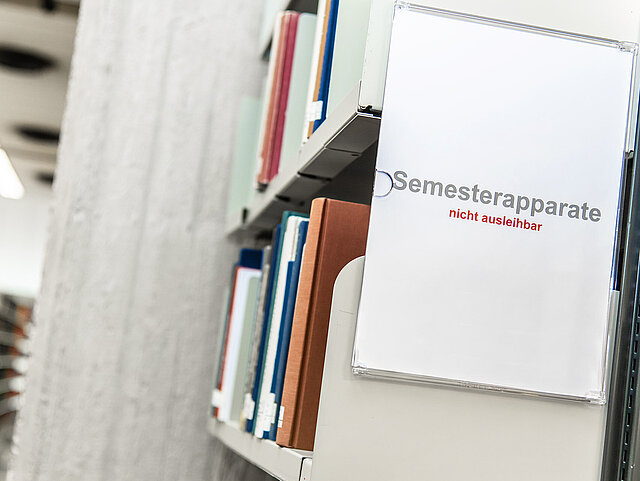
The course collections are made available in the Central Library as well as in the subject libraries on specially marked shelves. The holdings stored here are for reference only. The items are identified in the ULB catalogue with the reference “Semesterapp.” together with the respective course number.

Media are usually released from a course collection again towards the end of the semester (usually in mid-March or mid-September).

Digital content is made available to course participants in electronic course collections. These course collections can include:

  • journals and chapters from books (as permitted by copyright laws, i.e. max. 15% of a copyrighted work) as PDF files
     
  • weblinks
     
  • your own files

For copyright reasons, the copyrighted documents made available in the course collections are deleted towards the end of the semester (end of March or end of September).

Therefore, please remember to save a copy of the required texts for yourself as necessary in good time.

HHU’s ILIAS learning management platform provides the technical basis for course collections. You’ll need to submit an activation request to the Centre for Information and Media Technology (ZIM) to be able to edit course collections in ILIAS. Following activation, teaching staff receive a link to the ULB catalogue in their ILIAS course, which includes a request option for books as well as journal articles and book chapters in a PDF format.

Instructions on how to prepare a course collection (German)

Copyright information (German)


Current print course collections

Semesterapparat Standort Nummer
Ausländerrecht - mit Bezügen zum allgemeinen Verwaltungsrecht und Verwaltungsprozessrecht FBJUR 001
Klinisches Denken und Handeln in Diagnostik und Therapie FBMED 001
Reading, Skimming, Gleaning, Scanning: Gathering Information PhilBib 001
Truth is stranger than fiction? Unreliable narrators and the truth of fiction PhilBib 002
Experiments in/with literature PhilBib 003
Diversität im Comic PhilBib 004
Hannah Arendt: ein Denken in Krisenzeiten PhilBib2 001
Blaise Pascal: Gedanken PhilBib2 002
Lektürekurs Philosophie des Mittelalters PhilBib2 003
Philosophie der Landschaft PhilBib2 004
Caesar: Leben und Rezeption PhilBib2 005
Philosophie des Mittelalters PhilBib2 006
Tierethik PhilBib2 007
Experimental Biophysics VBNW 003
Lineare Algebra I VBNW 004
Literaturen im transkulturellen Raum Bolivien: Prosa, Lyrik, Theater ZB01 001
BFM 2-1a u. BFM 2-2a Tod und Sterben in der Literatur des Fin de Siècle ZB01 002
BFM 2-1a/BFM 2-2a Lyrikerinnen von der Renaissance bis zur Gegenwart ZB01 003
BFM 2-1a / 2-2a Lyrikerinnen von der Renaissance bis zur Gegenwart (18./19. Jahrhundert) ZB01 004
BVM 2c Geburt, Tod und Wiederauferstehung der Autorschaft ZB01 005
Die Anime-Serie Attack on Titan durch die Linse unterschiedlicher Forschungsdisziplinen ZB01 006
Karl der Große (Aufbauseminar mit Tagesexkursion nach Aachen) ZB02 001
Rastafari in der Globalgeschichte ZB02 002
Hexenverfolgungen in Osteuropa in der Frühen Neuzeit (Blockseminar) ZB02 003
Die Jugoslawien-Kriege 1991-2001 ZB02 004
Städte, Wälder, Ozeane: Orte des künstlerischen Widerstands gegen globale Krisen ZB03 001
Kunst und Politik auf der Biennale Venedig ZB03 005
Feuer, Wasser, Erde, Luft – Die vier Elemente als gestalterisches Mittel in der Kunst ZB03 006
Von Marcel Duchamp bis Wu Tsang: Kunst des 20. und 21. Jahrhunderts ZB03 007
Familienbande, Inspiration und Rivalität: Die Bellinis, Mantegna und die Renaissance in Venedig ZB03 008
Responsible for the content: Dezernat Benutzung : Contact by e-mail